Paint in the Dark: The Night Muralists Transforming America's Concrete Canvas
Photo: Fons Heijnsbroek, CC0, via Wikimedia Commons
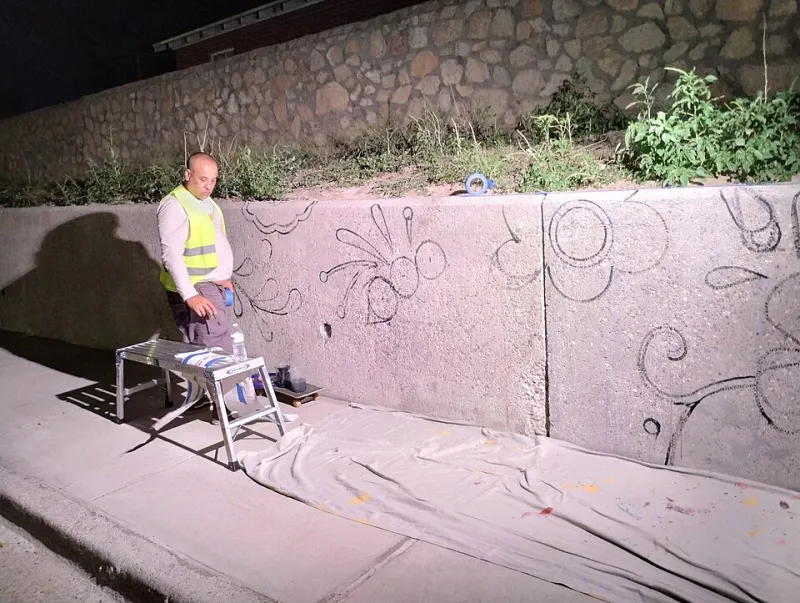
It's 2:47 a.m. on the east side of Los Angeles, and a woman who goes by Luma is halfway up a rickety extension ladder, adding the final gradients to a twelve-foot portrait of her late grandmother. The nearest streetlight is half a block away. She's working mostly by headlamp and muscle memory, and she has maybe ninety minutes before the sky starts to lighten. She's not nervous. She's been doing this for six years.
"The night gives you something the day never can," she tells me, not breaking her rhythm. "Nobody's watching. Nobody's judging. It's just you and the wall."
Luma is part of a growing, loosely connected movement of nocturnal muralists operating across American cities — artists who have traded gallery openings and daylight commissions for the strange, charged freedom of working after dark. And what they're creating is anything but simple tagging. These are full-scale, technically sophisticated works that rival anything you'd find in a curated public art program. The difference is the clock.
From Tags to Tapestries
Street art's relationship with nighttime is as old as the culture itself. The early writers of 1970s New York subway yards worked at night out of pure necessity — transit authorities weren't exactly handing out permission slips. But the nature of what's being made has shifted dramatically. Where a tag might take thirty seconds, today's nocturnal murals can require multiple nights of layered work, projection mapping for scale, and teams of collaborators operating in near-silence.
Chicago-based collective Dark Meridian is a good example of how far the form has traveled. The group — five artists who prefer to remain unnamed individually — uses a combination of wheat paste, aerosol, and hand-painted detail to produce pieces that look, in daylight, like they've been there for decades. Their signature style blends Chicago architectural motifs with Afrofuturist imagery, and their walls have started appearing in Pilsen, Bronzeville, and along the Milwaukee Avenue corridor.
"We plan everything in advance," one member explains over Signal. "Reference photos, color swatches, measurements. By the time we show up at 1 a.m., we know exactly what we're doing. The night is just when we execute."
Legal or Not, the Work Endures
Here's where things get complicated. Not every wall these artists touch belongs to a sympathetic landlord. The tension between unauthorized street art and the increasing legitimization of mural culture runs straight through the heart of this scene, and nobody pretends otherwise.
In New York, the city's Cultural Affairs department has expanded its public art budget significantly over the past five years, commissioning large-scale murals in neighborhoods from the South Bronx to Far Rockaway. Many of those commissioned artists cut their teeth doing unsanctioned work. The pipeline from illegal wall to city-sponsored installation is, for some, a natural career arc.
But not everyone wants the commission. "The moment you have a permit, you have a client," says a Brooklyn-based artist who works exclusively without authorization and asked to be identified only as Greco. "The wall tells you what it needs. A committee doesn't."
Greco's work — enormous, hyperrealistic figures that seem to emerge from the building's own surface — has been documented extensively on social media, even as the pieces themselves get buffed by property owners or painted over by rivals. He's philosophical about impermanence. "Every piece I make is already gone in my head. That frees me up to go bigger."
Cities Are Starting to Pay Attention
What's interesting is how municipal attitudes are shifting. Los Angeles, long a battleground between street artists and the city's anti-graffiti bureau, has quietly expanded the number of designated mural corridors where artists can work with minimal bureaucratic friction. The result has been an explosion of large-format work in neighborhoods like Highland Park, Boyle Heights, and Leimert Park — many of it created during nighttime hours simply because the artists work day jobs.
Chicago's Department of Cultural Affairs and Special Events has begun actively recruiting artists with street backgrounds for public commissions, explicitly valuing what one program coordinator called "the urgency and directness that comes from working outside traditional systems."
New York remains the most contested terrain. The city's relationship with street art is famously contradictory — prosecuting some artists while celebrating others — but even here, community boards in neighborhoods like Bushwick and Washington Heights have started advocating for more flexible public art policies that acknowledge the reality of how murals actually get made.
The Night as Creative Necessity
Beyond the legal calculus, there's something else going on. For many of these artists, nighttime isn't just a tactical choice — it's an aesthetic one. The quality of light changes the work. Colors read differently under sodium vapor lamps. The absence of daytime noise creates a kind of focused silence that, several artists told me independently, makes them more productive than any studio environment.
Luma, back on her ladder in East LA, puts it simply: "I've tried doing this during the day with permission. It's fine. But it's not the same feeling. There's something about the city at night — it's like it's breathing differently. And I want my work to have that in it."
By the time she packs up her ladder and loads her van, the portrait is done. Her grandmother's face looks out from the wall of a former auto-body shop, dignified and enormous and utterly at home in the pre-dawn quiet. In a few hours, the neighborhood will wake up and someone will see it for the first time.
That's the thing about night work: the reveal is always someone else's morning.