Spin Cycle Souls: Why the 24-Hour Laundromat Is America's Most Honest Gathering Place
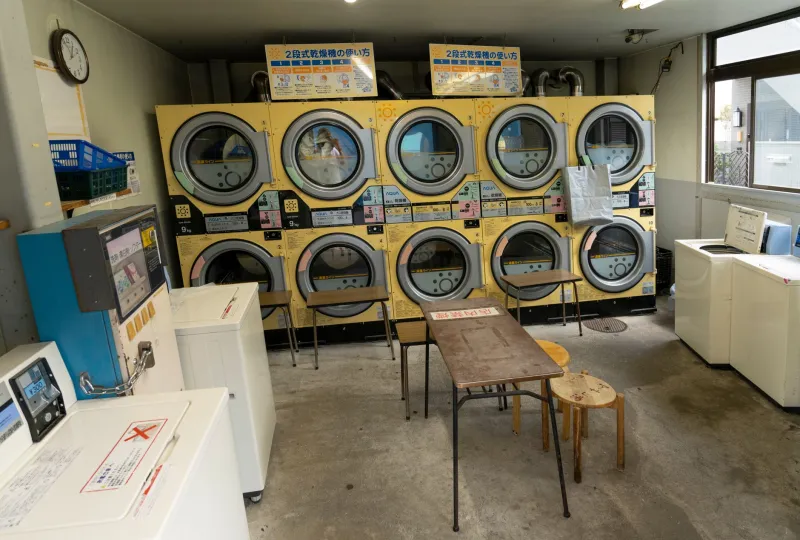
It's 2:47 in the morning and a woman named Darlene is folding a fitted sheet with the focused patience of someone who has done this ten thousand times. Across the row of plastic chairs, a young guy in kitchen whites stares at his phone, his chef's coat tumbling behind a porthole of soapy glass. A security guard nurses a vending machine coffee. Nobody is talking, but nobody feels alone.
This is the laundromat at night — and if you've never been inside one past midnight, you've been missing one of the most quietly radical social experiments in American urban life.
The Room That Never Closes
There are roughly 20,000 coin laundries operating across the United States, and a significant chunk of them run around the clock. They exist in the gaps — between the apartment with no washer hookups and the paycheck that doesn't quite stretch to a building with amenities. They sit on corners in neighborhoods that big-box retail abandoned, in strip malls between check-cashing spots and nail salons, on blocks where the only other light at 3 AM is a gas station sign.
What urban planners and sociologists are slowly beginning to notice — what night-shift workers and insomniacs have known forever — is that these spaces function as something far more complex than a utility stop. They're third places in the truest sense of the term: not home, not work, but somewhere in between. Somewhere that asks almost nothing of you except quarters.
The sociologist Ray Oldenburg coined the "third place" concept back in the '80s to describe informal gathering spots that anchor community life — barbershops, diners, corner bars. He probably wasn't thinking about a row of Speed Queen washers under a flickering tube light, but the laundromat at night fits the definition almost perfectly. It's accessible, it's unpretentious, and it levels the social playing field in a way that most American spaces no longer do.
Who's Actually There
The overnight laundromat runs on a specific economy of people. Hospital workers. Hotel housekeeping staff. Cooks and line cooks and dishwashers getting off late shifts. New parents running on fumes. College students who miscalculated their week. Folks experiencing housing instability who have nowhere else to go but need to be somewhere safe and warm and lit.
In cities like Chicago, Houston, and Los Angeles — where the service industry never really sleeps — these spaces absorb the overflow of the night economy. The people folding clothes at 4 AM are frequently the same people who kept your city running while you were asleep. They cleaned your hotel room, cooked your late-night order, stocked the shelves you'd browse the next morning. The laundromat is where they decompress.
Talk to enough of them and patterns emerge. People describe the laundromat as "peaceful in a weird way" — the white noise of machines, the warmth, the absence of the usual social performance that daylight hours demand. You're not there to be seen. You're there because your clothes are dirty and you need clean ones. That shared honesty strips something loose.
Accidental Architecture of Connection
The physical design of a laundromat almost forces a certain kind of intimacy. The rows of plastic chairs face each other. The machines run for 28 to 45 minutes a cycle, long enough to get bored, short enough that leaving feels wasteful. There's a captive quality to it — you're not scrolling past this interaction, you're sitting inside it.
Owners of long-running laundromats will tell you they've watched romances start over a shared fabric softener, seen friendships form between people who have nothing in common except a broken dryer in their building. In some neighborhoods, particularly in immigrant communities, the laundromat functions as an informal information hub — a place to learn which landlord is decent, which employer is hiring, which community organization has resources.
In New York's Washington Heights and Jackson Heights, in Chicago's Pilsen and Little Village, in Houston's East End, the overnight laundromat is woven into the fabric of neighborhood life in ways that are hard to quantify but immediately felt. These aren't just service stops. They're rooms where the city tells itself the truth.
The Culture That's Been There All Along
Artists and photographers have circled this world for decades. Nan Goldin captured laundromat intimacy in her early work. Countless indie films have used the all-night coin laundry as shorthand for a particular kind of urban loneliness — though loneliness might be the wrong word. Solitude, maybe. Or the strange comfort of being anonymous in proximity.
More recently, a handful of photographers and documentarians have started treating the overnight laundromat as a subject worthy of serious attention rather than mere atmospheric backdrop. Projects like these turn up in zines and local gallery shows, capturing the specific texture of that fluorescent light on tired faces, the steam rising from industrial dryers, the hand-lettered signs taped to machines that have been out of order since 2019.
There's a visual language to these spaces that belongs entirely to them — the faded murals some owners paint to make the walls less bleak, the community bulletin boards layered with flyers in three languages, the small altars and good-luck charms some attendants keep near the change machines. It's not glamorous, but it's deeply, stubbornly human.
What the City Owes These Rooms
Here's the uncomfortable part: most 24-hour laundromats are barely surviving. Commercial rents in cities keep climbing. The machines are expensive to maintain. The clientele, by definition, isn't wealthy. In neighborhood after neighborhood, the all-night laundromat is one bad lease renewal away from becoming a smoothie franchise or a pop-up retail space.
When that happens — and it keeps happening — what disappears isn't just a place to wash clothes. It's a node of informal community infrastructure that nobody officially built and nobody officially funds, but that a whole ecosystem of night-shift workers and low-income residents quietly depends on.
Some cities have started to recognize this. Community development organizations in Philadelphia and Detroit have experimented with laundromat-anchored community spaces — adding Wi-Fi, programming, even small libraries. The model works because the bones are already there. The room already knows how to hold people.
Still Spinning
Back in that laundromat at 2:47 AM, Darlene finishes her fitted sheet with a small, satisfied snap. The guy in kitchen whites pulls his chef's coat from the dryer and holds it up to check for stains. The security guard tosses his cup and heads back out to the parking lot.
They didn't exchange much. Maybe a nod, a comment about the broken dryer in the back, a shared eye-roll at the vending machine that ate a dollar. But they were there together, in the warmest room on the block, while the rest of the city pretended it was asleep.
That's the thing about the all-night laundromat. It doesn't try to be a community space. It doesn't brand itself or market the experience. It just stays open, keeps the lights on, and lets the city's night people find each other in the spin cycle glow.
Some of the most honest culture in America gets made in rooms nobody's paying attention to. This is one of them.