Broadcast from the Underside: The Late-Night Podcasters Turning City Folklore into Living Myth
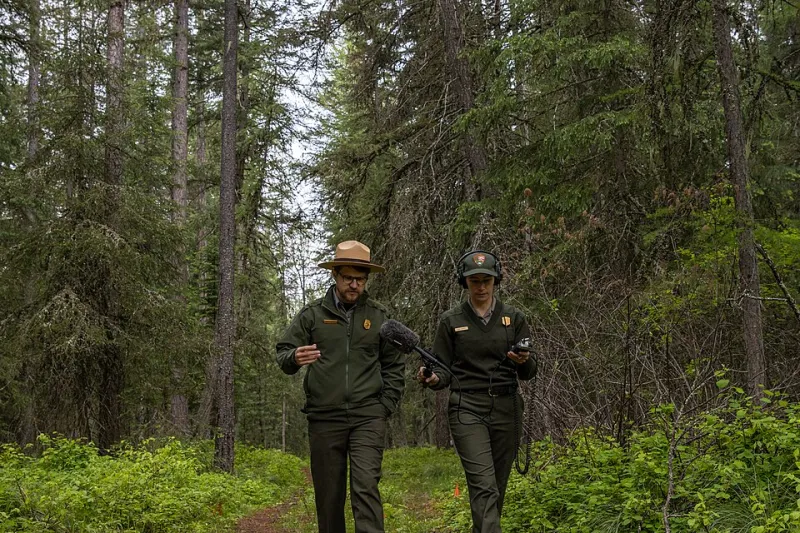
Photo: GlacierNPS, Public domain, via Wikimedia Commons
The recording starts with ambient sound — the low hum of a freight elevator, the distant bark of a dog echoing off brick, the particular silence of a city block that used to be something else. Then a voice: "This building has been empty for eleven years. But the people who lived here never really left. Let me tell you what I mean by that."
This is Concrete Memory, a podcast recorded exclusively in and around Chicago's South Side between the hours of 11 PM and 4 AM. Its host, who goes by the name Solano, records every episode on location — inside shuttered warehouses, on rooftops, in the back corners of all-night laundromats. He's never used a studio. He says studios kill the thing he's trying to catch.
Solano is part of a growing wave of independent podcasters who have decided that the story of American cities can't be told from a desk. They're working in the dark, literally and figuratively, using the overnight hours and the physical spaces of their cities as co-authors. The result is something that sits somewhere between oral history, ghost story, and urban mythology — and it's finding audiences that traditional media never reaches.
Why the Night Changes the Story
There's a reason these creators aren't recording at noon. Nighttime has always been when folklore lives. Ghost stories, urban legends, neighborhood gossip that becomes neighborhood gospel — this material has always circulated after dark, in bars and on stoops and in the back of cabs. These podcasters are simply formalizing that tradition for the earbuds-and-Spotify generation.
Kira Espinoza hosts Below the Boulevard, a podcast about the underground history of Los Angeles that she records walking through neighborhoods between midnight and 3 AM. Her episodes cover everything from the real history of tunnels beneath downtown LA to the oral traditions of communities that have been displaced by development so many times their stories exist nowhere in the official record.
"Historians go to archives," Espinoza says. "I go to the people who are still awake at 1 AM because they've got nowhere else to be. That's where the real archive is."
The decision to record at night isn't just atmospheric — it's practical. The ambient noise of daytime cities is chaotic and uncontrolled. At night, sound becomes more deliberate. The things you hear after midnight in an American city are the things that are stubborn enough to still be there: the infrastructure, the animals, the people who exist outside the nine-to-five economy. For podcasters working with location audio, that's gold.
Folklore as Resistance
A lot of what these podcasters are doing is, quietly, political. When you record an episode about the history of a neighborhood that's being gentrified — when you interview the woman who's lived in the same apartment for forty years and knows every family that's come and gone from every unit — you're doing something that urban development PR campaigns would rather not exist.
Darnell Whitmore's podcast Ghost Blocks focuses on neighborhoods in Baltimore and Philadelphia that have been systematically erased from the cultural conversation. He records episodes in the spaces themselves — an empty lot where a community center used to stand, a block of rowhomes with boards over the windows — and layers in interviews, archival audio when he can find it, and his own narration, which tends toward the lyrical.
"Mythology isn't just ancient stuff," Whitmore explains. "Mythology is what a community tells itself to survive. When those stories stop being told, the community is easier to erase. I'm just trying to make sure some of these stories don't disappear."
This is oral history, yes, but it's oral history remixed for an audience that grew up on true crime podcasts and lo-fi hip-hop playlists. The production values are intentionally rough. The silences are left in. A siren in the background isn't edited out — it becomes part of the texture of the piece.
The Architecture of a New Mythology
What distinguishes the best of this work from simple storytelling is the way these creators treat place itself as a character. Buildings have personalities in their episodes. Streets have emotional histories. The city isn't a backdrop — it's a narrator.
Solano describes his process as "letting the building talk first." He'll spend an hour in a location before he starts recording, just listening. What does the space sound like? What does it feel like? What story is it already telling before he opens his mouth?
This is ancient practice dressed in modern tech. Indigenous oral traditions, West African griots, the storytelling cultures of immigrant communities in American cities — all of them understood that place and story are inseparable. These podcasters are rediscovering that truth through a microphone and a pair of headphones.
"Every neighborhood has a mythology," Espinoza says. "Most of it just hasn't been recorded yet. Or it has been recorded, but by people who didn't live there and got it wrong."
The Audience That Found Them
Here's the surprising part: people are listening. Not millions of people — this isn't Serial or Stuff You Should Know territory. But the audiences these podcasters are building are deeply engaged in ways that mainstream podcast metrics don't fully capture. Listeners show up to locations mentioned in episodes. They send in their own neighborhood stories. They form Discord servers and organize their own overnight urban history walks.
The format has also started to influence how younger creators think about what a podcast can be. The idea that you have to be in a soundproofed room with a professional mic to make something worth hearing is losing ground. Some of the most compelling audio storytelling happening right now is being recorded on a phone, in the dark, in a city that most people drive through without ever really seeing.
That's the thing about working the overnight shift as a storyteller. The city saves its most honest material for the people willing to stay up for it. These podcasters are taking notes.
And somewhere tonight, in a neighborhood that doesn't make the tourist maps, someone is hitting record.