Grease and Neon: The All-Night Wrench Turners Keeping America's Cities in Motion
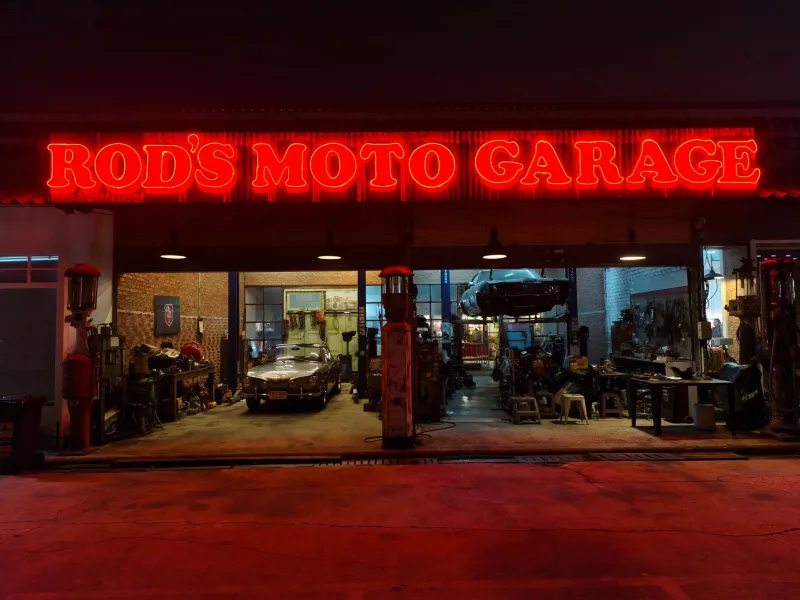
It's 1:47 AM on a Tuesday somewhere in South Los Angeles, and the smell of motor oil is thick enough to taste. A pair of fluorescent shop lights buzz over a lifted Honda Civic, its hood open like a confession. Three people crouch around the engine bay, speaking in the shorthand of people who've done this a thousand times — part diagnosis, part ritual. Nobody's getting paid by the hour. Nobody's punching a clock.
This is the other shift. The one that doesn't show up in economic reports or chamber of commerce newsletters. And in cities from Houston to Detroit to Baltimore, it runs every single night.
The Economy That Runs on RPMs
America's official auto repair industry operates on banker's hours. Most shops close by six, and even the ambitious ones rarely push past eight. But the people who actually need their cars fixed — the overnight warehouse workers, the rideshare drivers grinding through a double, the single parent whose check engine light came on at 11 PM and who absolutely cannot miss tomorrow's shift — they exist outside that window entirely.
That's where the underground fills in.
Across the country, informal repair networks have quietly built an economy that runs parallel to the licensed shop world. Some of it is cash-only work out of residential driveways. Some of it is mechanics who hold day jobs and wrench on the side after dark, turning a two-car garage into a neighborhood resource. In cities like Chicago and Miami, whole blocks have developed reputations as places you can roll up late with a busted alternator and leave with a running car before sunrise.
"People in my neighborhood can't afford to take a day off work to sit at a shop," says one Houston-based mechanic who asked to stay anonymous. "So I work when they can work. That's midnight. That's 2 AM. That's however long it takes."
The rates are usually lower. The trust, surprisingly, is often higher.
Meet Night at the Car Meet
But underground car culture after dark isn't only about necessity — it's also about love. Real, obsessive, borderline-irrational love for machines.
Late-night car meets have become one of the most vibrant and misunderstood subcultures in urban America. They happen in empty big-box parking lots, under highway overpasses, at the edges of industrial parks. Word spreads through Instagram DMs and Discord servers and old-fashioned word of mouth. You show up, you park, you walk around and look at what people have built.
And what they've built is genuinely stunning.
Customized lowriders with hydraulic setups that took years to engineer. JDM imports with engine swaps that required fabricating parts from scratch. Muscle cars with paint jobs that belong in a gallery. The craft on display at these meets rivals anything happening in a formal automotive design studio — except the designers here learned by doing, not by getting a degree.
"People don't realize how much skill goes into this," says a customizer from the Dallas-Fort Worth area who goes by the handle Torque_Vis. "I've got guys in my crew who can do bodywork that body shops would charge ten grand for. They learned it themselves. They taught each other. That knowledge lives in the community."
The culture has its own aesthetics, its own music, its own hierarchy. It has beef and alliances. It has mentors and prodigies. It is, in every meaningful sense, a scene — one that just happens to operate under streetlights instead of gallery lighting.
The Legal Gray Zone
Of course, not everything in the midnight car world exists in comfortable legal territory, and it would be dishonest to pretend otherwise.
Street racing is real, and it's dangerous. Cities from Atlanta to Seattle have grappled with the tension between cracking down on illegal racing and understanding why it exists — often in the same neighborhoods where youth have the least access to sanctioned motorsports programs or safe recreational infrastructure. The risk isn't lost on the people involved. But neither is the thrill, or the community, or the sense that this particular slice of the street belongs to them in a way nothing else does.
The informal repair economy also operates outside licensing requirements, which creates genuine consumer protection questions. A bad repair at 2 AM has no warranty, no recourse. That's a real vulnerability, especially in communities where options are already limited.
But policing the gray zone without replacing what it provides has historically just left people stranded — literally and figuratively. The underground persists because the gap it fills is real.
Grease as Inheritance
What often gets missed in coverage of car culture — when it gets covered at all — is the generational dimension. These aren't just hobbies. They're transmission lines for knowledge and identity.
In Latino communities across the Southwest, lowrider culture is explicitly tied to family history, with cars passed down through generations and modified over decades as living heirlooms. In Black neighborhoods in cities like Detroit and Memphis, the tradition of backyard mechanics traces directly to the era of sundown towns and discriminatory service refusals — when getting your car fixed by a white-owned shop wasn't always a safe or available option. You learned to do it yourself. You taught your kids. The skill became self-determination.
That history doesn't disappear when the sun goes down. If anything, it gets more concentrated. The late-night garage is a classroom, a community center, and a cultural archive all at once.
The City That Runs on Engines
Goodnight Traffic City is built on a simple truth: the city doesn't actually stop. It just changes shifts. And the people who keep it moving during those dark hours — the ones keeping the delivery vans running, the rideshare cars operational, the personal vehicles of working people road-worthy — are doing something essential.
They're also doing something beautiful, even when it's covered in grease and happening under a single work light at three in the morning. There's an artistry to a well-tuned engine, a creativity in a custom build, a community in the shared language of people who speak in torque specs and gear ratios.
The midnight mechanics aren't waiting for permission or recognition. They're already out there, wrenches in hand, keeping the whole thing rolling.
Somewhere tonight, an engine turns over that wouldn't have without them. The city moves. The night shift continues.