Midnight Routes: The Overnight Delivery Workers Turning America's Empty Streets Into Art
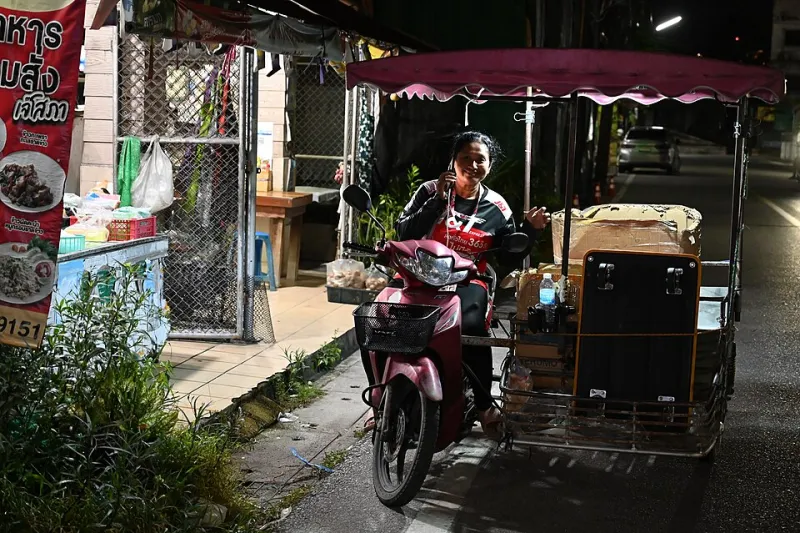
Photo: PattayaPatrol, CC BY-SA 4.0, via Wikimedia Commons
The city looks different at 3 AM. You probably know this in theory. But if you've never actually driven it — really driven it, night after night, the same route, the same overpasses, the same gas stations glowing like little planets — you don't know it the way a delivery driver knows it.
America's overnight logistics workforce is enormous, largely invisible, and almost entirely underdiscussed in conversations about urban culture. These are the people who keep the city's supply chain breathing while the city itself is unconscious. And increasingly, they're also the people making some of the most interesting, underrated creative work happening in American streets right now.
The Invisible Infrastructure
Before we get to the art, it's worth sitting with the scale of what we're talking about. There are roughly 3.5 million delivery drivers in the United States, and a significant chunk of them are working overnight — for Amazon, FedEx, USPS, regional freight companies, food delivery platforms, and a dozen other gig-economy variations on the same basic premise. Add warehouse workers, last-mile logistics crews, and overnight stock teams, and you've got a workforce that could fill several major cities, all of them awake and moving while the rest of the country dreams.
They see things. That's the starting point for everything else.
"I've driven the same twelve-mile route in Atlanta for three years," says Marcus Webb, who works overnight deliveries for a regional freight company. "I know every pothole. I know where the foxes come out. I know which parking lots the teenagers use on weekends and which ones are empty by 2 AM. I know this city in a way that most people who live here never will."
That knowledge — granular, embodied, accumulated through repetition — has started finding its way into creative expression in ways that are genuinely surprising.
TikTok at 4 AM
The most visible outlet, predictably, is short-form video. A loose but growing community of overnight workers has taken to TikTok and Instagram Reels to document what their routes actually look like — and the results are frequently stunning. Empty eight-lane highways filmed from the cab of a truck. Warehouse loading docks lit up like movie sets. The specific, eerie beauty of a city's commercial district when absolutely no one is there.
@nightfreight, an account run by a FedEx driver in the Dallas–Fort Worth metro area, has built a following of over 200,000 people posting exactly this kind of content. The videos are quiet, often unscored, and shot on a phone mount attached to the dashboard. They're almost meditative. The comments are full of people saying some version of "I didn't know our city looked like this."
That reaction — surprise at the familiar — is exactly what good documentary work does. And whether or not the people making these videos would describe themselves as documentarians, that's functionally what they are.
"I started filming because I was bored," admits the person behind @nightfreight, who asked to stay anonymous. "But then I started watching back my own videos and I was like — this is actually beautiful? Like, I drive past this overpass every single night and I never really looked at it. When you film it, you look at it."
Zine Culture and the Loading Dock
Not everyone is working in video. A smaller but deeply committed contingent of overnight workers has been producing physical zines — photocopied, hand-stapled, distributed at break rooms and truck stops and via mail order — that document the experience of working the night shift in America's logistics economy.
One of the most talked-about in the community is a zine called Overnight Rate, produced out of a distribution warehouse in Columbus, Ohio. It's been running for three years, releasing roughly four issues annually, and it mixes photography, short essays, hand-drawn maps of routes, and occasional poetry into something that reads like a love letter to the unglamorous and essential.
The editorial voice is sharp and funny and occasionally furious — about working conditions, about the gig economy's particular brand of precarity, about being invisible to the people whose packages you're delivering. But it's also genuinely tender about the night itself, about the camaraderie that develops between people who share strange hours.
"There's a solidarity that comes from being awake when you're not supposed to be," reads one essay from the second issue. "We all know the same gas stations. We all know the same 24-hour diners. We all know what it means to watch the sunrise from the wrong side of a shift."
The Sound of the Route
Music is the other thread running through this culture, and it makes sense — driving alone for six hours is, among other things, a listening experience. Playlists become almost ritualistic. Certain albums get permanently associated with certain stretches of highway.
Some overnight workers have started sharing these playlists publicly, framing them explicitly as sonic documents of their routes. A warehouse worker in Chicago who goes by the handle Logistical_Ghost on SoundCloud has been uploading hour-long ambient mixes described as "music for the 3 AM highway" — and the project has found an audience that extends well beyond logistics workers.
"I make music for the feeling of driving somewhere that's yours because nobody else is there," they wrote in a post accompanying one release. That description could stand as a mission statement for this entire creative movement, such as it is.
Working-Class Art Has Always Been Here
It's worth being honest about what's actually new here and what isn't. Working-class people have always made art. The overnight shift has always had its own culture — its own humor, its own rituals, its own way of making the unbearable bearable. What's changed is visibility. Smartphones, social media, and a post-pandemic cultural moment that has made more people curious about essential workers have created conditions where this creativity can actually surface and find an audience.
The risk, of course, is that it gets aestheticized in ways that strip it of its politics. The overnight delivery worker's TikTok goes viral and suddenly it's an "aesthetic" — dark highways, lo-fi beats, the romance of labor — without anyone engaging seriously with what it costs to do that job night after night.
The best of this work resists that flattening. Overnight Rate does it through anger as much as beauty. Logistical_Ghost does it by making music that's uncomfortable to sit with, not just pretty. The @nightfreight videos do it by being relentlessly mundane — no soundtrack, no filters, just the actual city, the actual route, the actual unglamorous reality of moving things through the dark.
The City Belongs to Whoever's Up
Goodnight Traffic City runs on the idea that the city never really sleeps — that after the offices close and the restaurants dim and the last train runs, something else takes over. Something truer, maybe. Something that belongs to whoever's still awake.
America's overnight delivery workers are awake. They have been for years. And they've been making art about it — on their phones, in their break rooms, in zines passed hand to hand at truck stops off the interstate.
The city is theirs between midnight and six. They've known that for a long time. The rest of us are just starting to pay attention.