Holding the Line at 3 AM: The Crisis Workers Who Keep America's Cities From Breaking Apart
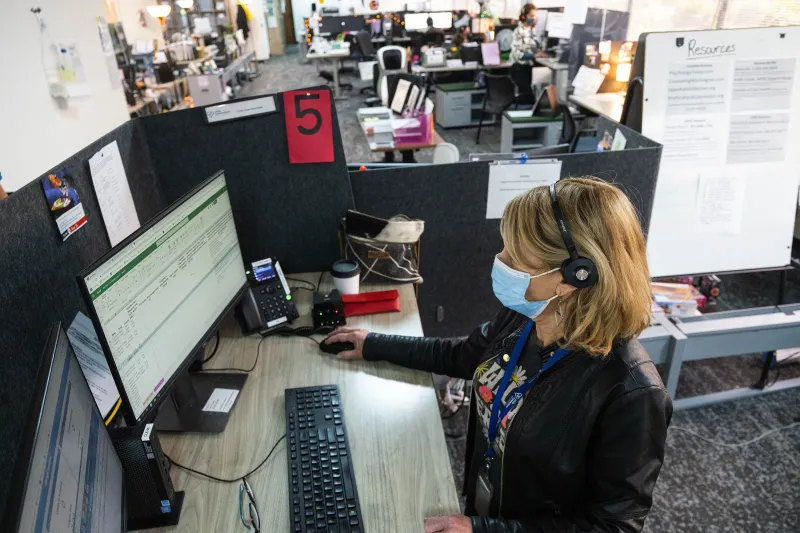
Photo: crisis hotline worker night office phone counseling, via www.inquirer.com
The call comes in at 3:11 AM. The voice on the other end is young — mid-twenties, maybe — and it's shaking in that particular way that tells Renata Osei everything she needs to know before a single word is spoken. She's been working the overnight crisis line in Baltimore for six years. She knows the shape of a breaking point.
"I just start talking," Renata says the next morning, hands wrapped around a coffee that's gone cold. "Not about the problem yet. Just talking. Letting them hear a voice that isn't panicking."
This is the work. Not glamorous, not well-compensated, not particularly visible. But essential in a way that the city's official mental health infrastructure — already strained to its limits during daylight hours — simply cannot replicate once the sun goes down.
Across America's cities, a loose and largely underfunded network of overnight crisis workers, peer counselors, and mobile response teams are doing something that doesn't show up in any civic budget meeting or mayoral press conference: they are keeping people alive through the hours when everything else is closed.
The Architecture of a Crisis
Mental health professionals have long understood that crisis doesn't operate on a 9-to-5 schedule. Anxiety peaks in the quiet. Grief gets louder when the distractions stop. The particular alchemy of exhaustion, isolation, and darkness that defines the late-night hours creates conditions that are genuinely distinct from anything experienced in the daytime — and the populations most affected are often those with the least access to traditional care.
Dr. Simone Achebe, a clinical psychologist in Houston who consults with several overnight crisis programs, describes the overnight window as "a different clinical landscape entirely." The people reaching out at 2 AM are often not the same people who make therapy appointments. They're the ones who've been told the waiting list is six months long. The ones whose insurance doesn't cover much. The ones who've never trusted a clinical setting in their lives but will, in a moment of crisis, reach for a phone.
"If nobody picks up," she says, "that's not a neutral outcome."
Peer Support and the Power of Shared Experience
One of the most significant shifts in overnight crisis work over the past decade has been the expansion of peer support — counselors who bring their own lived experience with mental health struggles to the work. In cities like Denver, Detroit, and Philadelphia, peer-led programs have moved into the overnight gap with a kind of credibility that traditional clinical approaches sometimes struggle to establish.
Darius Webb runs a peer support line in Detroit that operates Thursday through Sunday nights, the hours his team identified as highest-need based on call volume data. He spent years in and out of the mental health system himself before training as a peer specialist. That history, he says, is the whole point.
"When someone calls at 2 AM and they're in a bad place, they don't want to feel like a case," he says. "They want to feel like they're talking to somebody who gets it. Who's been in that dark room."
The line gets flooded on weekends — after the bars close, after the parties end, in the particular crash that follows forced socialization. Darius and his team of eight volunteers field calls that range from acute crisis to profound loneliness, and they treat both with the same weight.
"Loneliness is a crisis," he says firmly. "We just don't call it that."
The Emotional Labor Nobody Accounts For
Here's what the job description doesn't say: you will carry these calls home with you. You will hear a voice in crisis and then, an hour later, you won't know how that person is. You will learn to hold uncertainty like a stone in your chest and keep working anyway.
Burnout in overnight crisis work is severe and well-documented. Renata has watched colleagues leave after six months, a year, two years — worn down by the cumulative weight of holding other people's worst moments. She's stayed, but she's deliberate about it. She goes to therapy herself. She runs. She has a group chat with other overnight workers where they process the stuff that doesn't go anywhere else.
"We take care of each other," she says. "Because nobody else is really set up to do it."
This is the structural problem lurking beneath the individual heroism. Overnight crisis work is chronically underfunded, often relying on grants, volunteer labor, and the dedication of people who could absolutely be making more money doing something else. The workers who answer the 3 AM calls are themselves operating without adequate support — a fact that should alarm anyone who thinks seriously about how cities function.
Mobile Response and the Shift Away From Police
In recent years, several cities have begun experimenting with mobile crisis response teams — unarmed mental health workers who respond in person to calls that would previously have defaulted to police. Programs in cities like Eugene, Oregon, and Denver have shown promising results, and the overnight expansion of these programs is one of the more significant developments in urban mental health infrastructure in decades.
The work is demanding in ways that are hard to fully describe. Showing up in person, in the dark, to a situation that is by definition unstable — and doing it with de-escalation and care rather than force — requires a specific combination of training, temperament, and nerve.
And yet the workers who do it describe the same thing, over and over: the moment when the situation turns. When someone who was unreachable becomes reachable. When the night gets a little less dark.
Renata's call from 3:11 AM lasts forty-seven minutes. By the end, the voice on the other end is steadier. Not fixed. Not resolved. But steadier.
She logs the call, stretches her neck, and picks up the next one.
The city keeps going. Someone has to hold the line.