Hot Grease and Holy Hours: What 3 AM Street Food Vendors Know About American Culture That Nobody Else Does
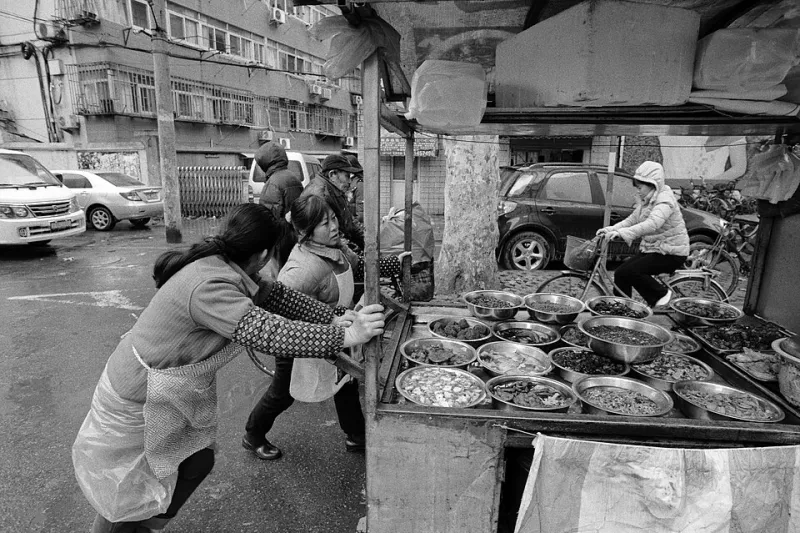
Photo: Stougard, CC BY-SA 3.0, via Wikimedia Commons
Let's be honest about something: the most culturally significant meal you'll eat in any American city probably won't happen in a restaurant with a reservation system, a curated wine list, or a chef who went to culinary school in Lyon. It'll happen at a cart. At an hour that rhymes with "last call." From someone who's been on their feet since before you started your second drink.
Late-night street food vendors are one of the great unacknowledged institutions of American urban life. And I don't mean that in a cute, quirky, food-blogger kind of way. I mean it seriously, structurally — the way you'd talk about libraries or community centers. These carts and trucks and folding-table setups are doing cultural work that no James Beard Award is going to recognize, and it's past time we talked about it like the big deal it actually is.
The Cart as Archive
Here's what a late-night food cart actually is, when you look at it straight: it's a living archive. Every elote cart in Chicago's Pilsen neighborhood, every halal cart parked outside a Manhattan club, every Oaxacan tlayuda stand running until 4 AM in South LA — each one of them is preserving and transmitting a specific culinary tradition in real time, adapted for the specific conditions of American urban life.
That adaptation part is crucial and almost always gets flattened out of the story. The narrative that food media loves — authentic immigrant food, unchanged, a portal to the motherland — is romantic but incomplete. The vendors themselves know this. Rosa Mendez has been running a tamale cart in Chicago's Humboldt Park neighborhood for eleven years. She starts setting up around 10 PM and runs until she sells out, which is usually somewhere between 2 and 3 AM.
"My grandmother's tamales are not my tamales," she says plainly. "Mine have things she never used. She never cooked for people who were drunk at 2 AM, either." She laughs, but she's making a real point. The late-night context shapes the food. Portions, heat level, texture, portability — all of it gets calibrated to the specific human being standing in front of you at that hour, in that city, in that neighborhood. It's not fusion for fusion's sake. It's living cuisine.
Who's Actually Out There
The late-night vendor ecosystem is extraordinarily diverse, and it maps pretty directly onto the immigration history of whatever city you're in. In Houston, you'll find Vietnamese bánh mì carts operating alongside Salvadoran pupusa setups and Nigerian suya grills, all within a few blocks of each other in the same nightlife corridor. In New York, the halal cart economy — dominated by Yemeni and Egyptian vendors — is so deeply woven into the city's identity that it's basically infrastructure at this point.
What's less discussed is how these vendors interact with each other. The late-night hours create a kind of informal community that daytime commerce rarely allows for. When foot traffic slows around 3:30 AM, vendors talk. They share intel about which blocks are getting ticketed, which events are letting out where, which new vendor is struggling and might need a referral. It's a mutual aid network running on steam trays and goodwill.
Jamal Osei, who runs a Ghanaian street food setup in Minneapolis on Thursday through Saturday nights, describes the late-night vendor community as "the most genuinely multicultural space" he's ever been part of. "We're all out here at the same weird hours, dealing with the same city regulations, the same weather, the same customers. It doesn't matter where you're from. You're out here."
The Gatekeeping Nobody Talks About
It would be incomplete to celebrate late-night street food culture without acknowledging how hard the city makes it for these vendors to exist. Permitting costs, zoning restrictions, health department requirements, police harassment — the bureaucratic and legal landscape that street food vendors navigate is genuinely brutal, and it falls disproportionately on vendors of color and immigrant vendors.
In Los Angeles, a city that has historically criminalized street vending, the 2018 decriminalization law was supposed to change things. And it did, somewhat. But the permitting process remains expensive and confusing, and enforcement remains inconsistent in ways that aren't random. Who gets hassled and who gets left alone correlates uncomfortably with race and neighborhood.
This is the political reality underneath the warm, delicious cultural story. The vendors preserving culinary traditions and feeding the city's creative class at 3 AM are doing it in spite of systems designed to make their work difficult. That's not a small thing. That's the whole thing, actually.
What They're Feeding (Beyond the Obvious)
Here's my actual thesis, and I'll just say it directly: late-night street food vendors are a load-bearing wall of American urban creative culture, and we've been treating them like a fun footnote.
Think about who's eating from these carts at 2 and 3 AM. It's not just bar-closers stumbling toward carbs. It's the musicians loading out after a show. The painters who work nights because the light in their studio is better then. The nurses finishing a shift. The warehouse workers clocking out. The DJs, the security guards, the hotel staff, the cab drivers. The people who make a city run when most of the city is asleep.
These vendors are feeding the night shift in every sense of the phrase. They're providing sustenance to the people who keep urban life operational and to the creatives who give it meaning. And they're doing it with food that carries history, identity, and genuine artistry — the kind of artistry that doesn't get gallery shows or design awards but shapes culture just as surely.
The next time you're standing at a cart at some ungodly hour, eating something that tastes like it was made by someone who genuinely cares — because it was — maybe think about what you're actually holding. It's not just dinner. It's an entire world, served hot, in the middle of the night, by someone who showed up when most people didn't.
That's not a footnote. That's the whole city.